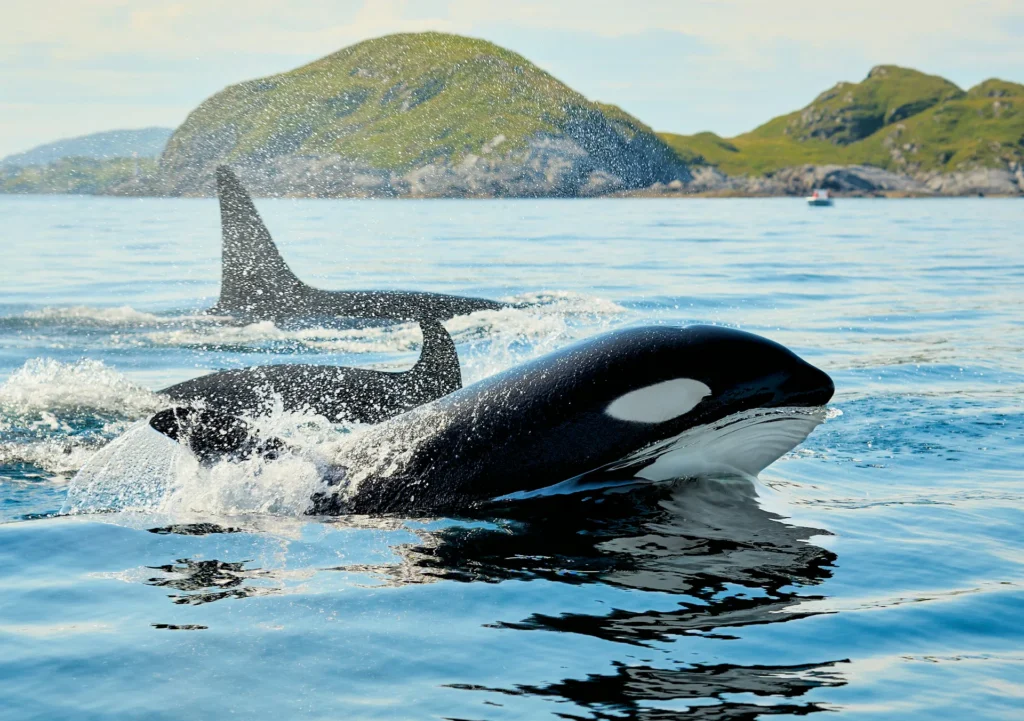
The case of the orcas Wikie and Keijo, which has drawn the attention of animal welfare organizations and legal experts in both Spain and France, originates from the closure of Marineland Antibes, the long-established marine park on the French Riviera that, for decades, was one of Europe’s leading facilities dedicated to the exhibition and exploitation of captive cetaceans. Wikie, an adult female born in 2001, and Keijo, her son born in 2013, belong to a lineage of orcas raised in artificial environments and used for years in aquatic performances designed for public entertainment.
The gradual implementation of the French animal welfare law of 2021 (Loi n° 2021-1539 du 30 novembre 2021 visant à lutter contre la maltraitance animale et conforter le lien entre les animaux et les hommes), which, among other measures, banned cetacean shows throughout the country, eventually led to the park’s closure in January 2025.
This legislative intervention forms part of a broader European reassessment of the practice of keeping marine mammals in captivity for entertainment purposes. At the heart of this reform lies a growing recognition (supported by an increasing body of scientific research) of the exceptional cognitive and social complexity of orcas and other cetaceans. A growing number of scholars and experts now regard permanent confinement in artificial environments as fundamentally incompatible with the welfare needs of these animals.
The legislation, however, failed to adequately address the fate of the animals that were already being housed in facilities such as Marineland, as well as in other marine parks and circuses across France, at the time the law was enacted.
The closure of Marineland Antibes has therefore highlighted one of the major shortcomings of recent European animal welfare legislation: the absence of a comprehensive legal framework governing animals already held in captivity when entertainment shows are abolished.
While the French legislature successfully prohibited future cetacean performances, it did not establish a clear relocation strategy based on what could be described as the animals’ best interests, nor did it provide a coherent framework for determining the most appropriate long-term solutions for the individuals already living in captivity.
As a result, the two orcas, mother and son, remain confined within the closed park more than a year after its shutdown, while French authorities continue to assess various relocation options. An initial proposal to transfer the animals to Japan, either to Kamogawa Sea World or Kobe Suma SeaWorld, was eventually abandoned. The plan was considered inconsistent with the objectives of French law, which seeks to bring an end to cetacean performances, and it was strongly opposed by non-governmental organizations concerned that it would merely perpetuate captivity in facilities dedicated to public exhibition.
At the same time, the Whale Sanctuary Project proposed relocating the animals to a semi-natural marine sanctuary in Canada, presenting a solution that many viewed as more consistent with both the spirit of the French legislation and the evolving principles of contemporary animal law.
It should be noted, however, that this alternative has not escaped criticism. Although the sanctuary planned for Port Hilford, Nova Scotia, has long been promoted as a potential refuge for cetaceans formerly held in captivity, the facility is not yet operational and has so far welcomed no animals. The project remains under development and requires the completion of complex infrastructure, as well as the issuance of the necessary environmental and administrative permits, which have not yet been secured. These circumstances have raised concerns about the sanctuary’s actual ability to provide a practical and timely solution to the problem.
A distinction must nevertheless be drawn between natural sanctuaries and sanctuaries designed for animals originating from captivity. The former are existing protected marine areas in which cetaceans live freely within natural ecosystems, such as the Valdés Peninsula in Argentina, the Francisco Coloane Marine Park in Chile, or the Pelagos Sanctuary in the Mediterranean. The latter, by contrast, are specially designed facilities created to accommodate animals originating from dolphinariums and aquariums. These animals have spent their entire lives in captivity, a condition that makes the transition to a semi-wild existence particularly challenging and, in some cases, potentially impossible to achieve fully.
Unfortunately, such facilities remain exceedingly rare today. Among the few currently in operation are the SEA LIFE Trust Beluga Whale Sanctuary in Iceland, Umah Lumba Rehabilitation, Release and Retirement Center in Indonesia, and Jonian Dolphin Conservation in Italy, all of which provide refuge for cetaceans formerly held in captivity.
The issue of climatic adaptation for Wikie and Keijo has also been the subject of intense debate within the scientific community, particularly regarding the significant temperature differences between Canadian waters and the Mediterranean environment in which the two orcas were born and raised. Critics have pointed to the potential challenges of acclimatization to colder waters, especially for animals that have spent their entire lives in captivity. At the same time, however, it must be acknowledged that orcas generally possess a remarkable capacity to adapt to a wide range of marine habitats. Climatic considerations alone, therefore, cannot be regarded as either a decisive criterion or an automatic obstacle to relocation.
Regardless of the climatic aspect, specific veterinary concerns associated with the transfer of cetaceans that have spent decades in artificial environments must also be taken into account. These include immunosuppression, dependence on human care, possible dermatological and metabolic disorders, and a broader physiological vulnerability resulting from long-term captivity.
In the case of Wikie and Keijo, the French authorities subsequently revised their position, concluding that the Canadian sanctuary project, in its current state, could not provide sufficiently prompt operational guarantees. At the same time, the gradual deterioration of the Marineland facilities and the absence of a fully operational sanctuary have strengthened the possibility of transferring the animals to Loro Parque in Tenerife, a Spanish facility that continues to host cetacean performances. Ironically, this solution closely resembles the previously abandoned proposal to relocate the orcas to Japan.
This further shift in policy has, unsurprisingly, prompted renewed criticism from animal welfare organizations, which argue that an emergency situation cannot justify a solution that contradicts the very objective pursued by French legislation: ending the exploitation of cetaceans. Such a transfer would create a fundamental inconsistency with the rationale of the law itself. Animals formally removed from captivity intended for exhibition and breeding purposes would simply be relocated to an essentially identical environment, albeit in a different country, where both breeding programs and public performances continue to take place.
Among the organizations advocating for a solution that prioritizes the welfare of the animals, the Captain Paul Watson Foundation and Sea Shepherd France have been particularly active, drawing attention to the issue since Marineland’s closure in January 2025. Throughout 2026, Paul Watson, one of the most iconic and influential figures in modern ocean conservation activism, addressed several open letters to the French authorities, urging them to adopt urgent measures to prevent the transfer of the orcas to another captive facility modeled on the former marine park in Antibes.
At the same time, Sea Shepherd France has conducted extensive public-awareness campaigns and institutional advocacy efforts aimed at opposing relocation to operational marine parks and promoting alternatives consistent with the gradual abandonment of the traditional marine-park model. The concerns raised by animal welfare organizations, however, extend beyond purely legal considerations and also encompass the management history of Loro Parque itself.
Several international reports published in recent years by organizations dedicated to cetacean protection, have highlighted the number of animal deaths recorded at the facility, as well as broader concerns regarding the conditions of its orca enclosures. According to these reports, one of the central issues in the controversy, concerns the park’s structural capacity to accommodate additional animals without compromising the minimum welfare standards required under European and Spanish law.
Lawyers representing the Captain Paul Watson Foundation argue that technical assessments, previously conducted by the Spanish Scientific Authority within the framework of the CITES (Convention on International Trade in Endangered Species of Wild Fauna and Flora) procedure, had already identified concerns relating to available space, pool depth, and the overall volume of the facilities designated for cetaceans. The dispute therefore extends far beyond a single administrative authorization process and directly raises the broader question of whether existing European infrastructures are genuinely suitable for the long-term confinement of large marine mammals.
Indeed, in 2025, the Spanish scientific authority responsible for CITES matters, reportedly refused to issue the permit required for the transfer of the two French orcas, concluding that Loro Parque’s facilities were not suitable for housing additional animals.
Loro Parque, however, challenged the decision, arguing that it had never been granted full access to the technical report upon which the Scientific Authority had based its conclusions. Should the park’s legal representatives succeed in demonstrating procedural irregularities, the effectiveness of the refusal could be significantly affected from a legal standpoint.
This possibility is currently viewed with particular concern by the organizations involved in the legal campaign on behalf of the Marineland orcas. They fear that the annulment of the decision on procedural grounds could create a form of “regulatory vacuum”, ultimately paving the way for the transfer of the animals while effectively circumventing the previous negative technical assessments.
The case of Wikie and Keijo therefore illustrates one of the most delicate issues in contemporary animal law: the increasingly complex interaction between substantive animal welfare protections and the procedural guarantees that characterize modern legal systems. The fate of the two orcas appears to depend not only on scientific and ethical considerations, but also on the outcome of legal and administrative processes.
In this respect, the case of the two French orcas may well become a landmark precedent with significant implications for the future regulation of captive cetaceans across Europe. The final decision of the Spanish authorities, together with any subsequent developments in the administrative litigation, could help shape new interpretative standards in the field of animal welfare law, more clearly defining the relationship between the economic interests of zoological institutions, international conservation obligations, and the effective protection of animals held in captivity.