Animal rights course returns at the University of Venice
The third edition of the WHALE course at the University of Venice gets under way, in collaboration with Animal Law…

The first Italian university module entirely dedicated to the law and rights of non-human animals, born from the collaboration between Ca' Foscari University of Venice and Animal Law Italia.
WHALE – Working on non-Human Animals Law and rights in the EU (2023-2026) is a Jean Monnet module funded by the European Union (ERASMUS-JMO-2023-HEI-TCH-RSCH, project no. 101127161), included among the official academic activities of Ca’ Foscari University of Venice and carried out in partnership with Animal Law Italia.
Conceived and coordinated by Professor Sara De Vido, Full Professor of International Law at the Department of Economics of Ca’ Foscari, with the contribution of lawyer Monica Gazzola, the module addresses the legal status of non-human animals in the European context from an interdisciplinary and critical perspective, weaving together law, philosophy, ethics and social sciences.
It is a unique case in the Italian academic landscape: for the first time the animal question enters university as a structured, multidisciplinary and topical legal subject, with an ecocentric approach that brings academic knowledge, legal professions and activism into dialogue.
The course is held every year for three years and is open to Ca’ Foscari students of all levels (with recognition of 12 ECTS credits), as well as to lawyers and trainee lawyers, in person and — for those enrolled outside the Venice Bar Association — also online, with continuing education credits recognized by the Venice Bar Council.
The lessons offer in-depth analysis of international law, European Union law and Italian law, with comparative insights, and are led by Ca’ Foscari professors, lawyers from Animal Law Italia, and experts and academics from other universities. Topics range from the EU legal framework on animal welfare to the rights of Nature, from criminal and civil law to animal testing, from hunting to bullfighting, up to the exploitation of animals in industry.
A distinctive element is the experiential approach: in the workshops, participants engage in rewriting real court rulings from an ecocentric and animal rights perspective, to demonstrate how current law, interpreted with awareness and openness, can open up spaces of protection far broader than commonly believed.
25
Students
38
Lawyers
41
Speakers
24
Lectures
13
Practical workshops
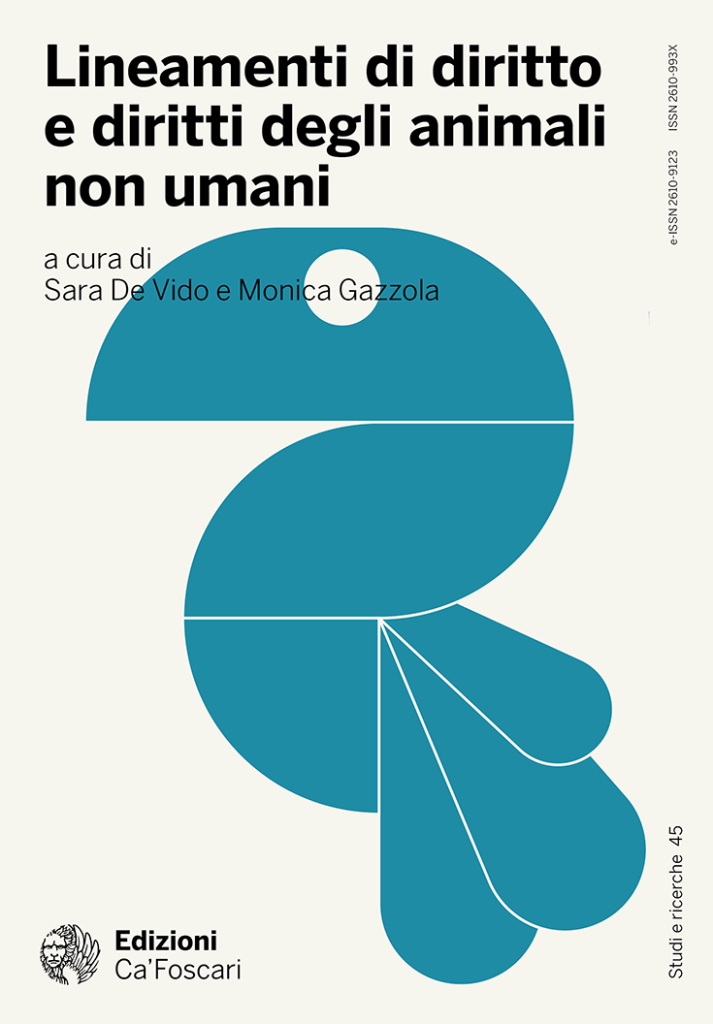
To strengthen the training path of the WHALE module, in 2025 the handbook Lineamenti di diritto e diritti degli animali non umani (Outlines of Law and Rights of Non-Human Animals) was published by Edizioni Ca’ Foscari in open access. The volume stems from the experience of the Jean Monnet project and brings together interdisciplinary contributions from legal scholars, philosophers and social science researchers, offering an updated and critical reading of the main legal challenges related to the protection of non-human animals, also in light of the most recent regulatory reforms.
Designed for students, for the legal and judicial professions, for activists and for those who work with animals or carry out educational roles, the book offers critical tools to understand how the law can evolve towards an increasingly concrete recognition of animals’ legal subjectivity.
From the educational experience of WHALE came the special issue of the Quaderni di Diritto degli Animali, our association’s scientific journal, entitled Animali non umani e nuove prospettive di tutela (Non-Human Animals and New Perspectives of Protection).
Edited by Dr. Silvia Zanini (University of Trieste) and Dr. Sara Dal Monico (Ca’ Foscari University of Venice), both members of the project’s scientific team, the issue brings together five contributions selected through a Call for Papers, all subjected to peer review and available in open access.
The contributions range from the transition towards animal-free science to the critique of anthropocentrism in environmental law, from the historical reconstruction of the relationship between religion and jurisprudence to the intersectional approach to animal subjectivity, up to the regulatory evolution of the category of «sentient being».
The issue closes with a collective work born directly from the course’s workshops, selected as the best paper of the first edition: the eco-legal rewriting of a 2023 ruling by the Court of Rome on the protection of crustaceans. An exercise that shows how current law can become a tool for real change, capable of overcoming anthropocentric logic and embracing new visions of justice.
All contributions to «Animali non umani e nuove prospettive di tutela» are available free of charge in open access on the journal’s website.
The course presentation, the full program and registration details are available on the official WHALE module page on the Ca’ Foscari University of Venice website. For any questions, you can write to whale.jm@unive.it.
Here you will find all the news and insights dedicated to the WHALE course and the activities born from the collaboration between Animal Law Italia and Ca' Foscari University of Venice.
The third edition of the WHALE course at the University of Venice gets under way, in collaboration with Animal Law…
This year's special issue of our association's journal is dedicated to the WHALE course at Ca' Foscari University of Venice.

A module developing new teaching, educational, research and policy-engagement activities on the legal protection of non-human animals at national and…