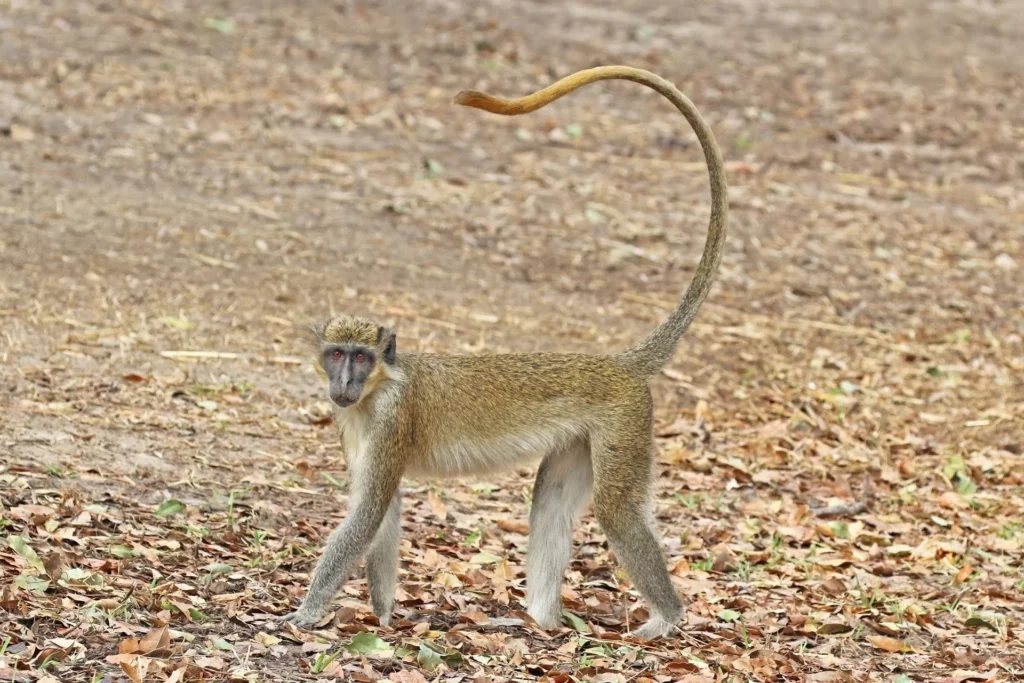
In the first days of August, well-known Neapolitan TikToker Rita De Crescenzo posted several videos on her social media channels, later removed, showing her in Sharm el-Sheikh with a baby monkey: the animal, very young, appears dressed in a t-shirt and a diaper, fed with a bottle and held in her arms like a newborn. According to press reports, it would be a green vervet monkey (Chlorocebus sabaeus), a species native to West Africa and not found in the wild in Egypt: a detail that, on its own, says a great deal about the commercial supply chain that baby monkey comes from.
The explanations provided by the person directly involved have been, to put it mildly, contradictory. At first she stated that she had bought the animal, even claiming to have bought two; she later claimed to have found it in a cardboard box and to have “taken it off the street.” No document attesting to its legal origin has ever been shown. She responded to criticism as follows: “I treat her like a daughter and she’s staying with me. I even bought her a Mickey Mouse plush toy.”
It is precisely this statement, in its disarming candor, that captures the problem.
A baby animal torn from its mother is not “treated like a daughter”
Primates are social animals with complex ethological needs: early separation from the mother — which in illegal trade often occurs by killing the mother herself — causes serious and permanent behavioral damage. Dressing a monkey, putting a diaper on it, feeding it with a bottle in front of a camera is not care: it is the denial of its nature, bent into entertainment content.
There is also a thoroughly contemporary aggravating factor: the showcase. Anyone who flaunts a wild animal in front of an audience of millions of followers sends the message that owning one is possible, legitimate and even cute. This is the copycat effect, well known to those who study wildlife trafficking: every video of this kind fuels demand, and demand fuels poaching.
What the CITES Convention provides
Legally speaking, the starting point is the Washington Convention on International Trade in Endangered Species (CITES), implemented in the European Union by Regulation (EC) No. 338/97. It is not even necessary to identify the baby animal’s species with certainty: the entire order of primates is included in Appendix I or Appendix II of the Convention. This means that international trade in any monkey is either prohibited for commercial purposes (Appendix I) or strictly subject to permits and certificates (Appendix II). The green vervet monkey falls under Appendix II: its export requires permits that no street souvenir vendor is able to issue.
Italian law provides for an absolute ban
If the animal were to set foot in Italy, the picture would be even clearer. Law No. 150 of 7 February 1992 — the law that criminally sanctions CITES violations in our legal system — punishes the import, possession, sale and transport of specimens lacking the required documentation: for species listed in Annex A, the penalty is imprisonment from six months to two years and a fine from 15,000 to 150,000 euros; for species listed in Annex B, a fine from 20,000 to 200,000 euros or imprisonment from six months to one year. In any case, confiscation of the specimen is always ordered (Art. 4).
But there is more. For a private citizen in Italy, keeping a monkey as a pet is absolutely prohibited, regardless of any documentation. Art. 6 of Law 150/1992 in fact prohibits keeping wild mammals and reptiles that may pose a danger to public health and safety, and the ministerial decree of 19 April 1996, which contains the list of such species, includes the entire order of primates, from lemurs to chimpanzees. Violation of the ban is punished with imprisonment of up to six months or a fine from 15,000 to 300,000 euros. The only exceptions concern zoos, protected areas, aquariums and scientific facilities declared suitable: certainly not private homes, no matter how well stocked with Mickey Mouse plush toys.
The framework became even stricter with Legislative Decree No. 135 of 5 August 2022, which introduced a ban on the import and keeping of wild and exotic animals taken from the wild, marking — at least on paper — the legislator’s intention to close the era of wild animals in Italian homes.
So why no action so far?
The reason the Italian authorities have not so far taken formal action is essentially territorial. The offences set out in Law 150/1992 arise when the specimen is brought into national territory or kept there: if the monkey has remained in Sharm el-Sheikh — where the influencer has long run a business — the matter falls under Egyptian jurisdiction. It should be noted that even in Egypt the conduct is not irrelevant: Law No. 4 of 1994 on the environment prohibits the capture, keeping and sale of wildlife, and since April of this year the use of monkeys in shows for tourists has also been banned.
If, on the other hand, the animal were brought — or had already been brought — into Italy without CITES permits and customs checks, the offences described above would immediately apply, with the intervention of the Forestry Carabinieri, seizure of the baby animal and a criminal complaint. Legally obtaining those permits for domestic use is simply impossible.
Our position
As Animal Law Italia we are following the case and trust that the competent authorities — Italian and Egyptian — will quickly establish where the animal is and arrange for its transfer to a suitable facility, the only outcome compatible with its welfare and with the law.
But this story is not just about an influencer. It concerns a market — that of selfies and exotic “pets” — which turns wild animals into accessories: babies torn from their mothers, transported in appalling conditions, condemned to an inadequate and often short life. A market that runs on demand, and demand is also built with a video that gets millions of views.
The appeal we make to readers is therefore twofold. First: do not buy, do not hold, do not photograph wild animals while on holiday, not even “to save them” — every baby animal bought on the street finances the capture of the next one. Second: if you come across content that flaunts the possession of wild animals, do not reward it with likes and shares; report it to the platform and, if the animal is in Italy, to the Forestry Carabinieri (environmental emergency number 1515).
Wild animals are not content. And they are not children to be dressed up: they are individuals with a life of their own, which the law — when applied — protects.