In recent days, the European Commission has presented two new trade agreements to the Member States: the EU-Mercosur Partnership Agreement (EMPA) and the Interim Trade Agreement (ITA). Despite strong opposition from the public and citizens, these texts are now back at the centre of the European political debate.
If ratified, the agreements would have devastating consequences for millions of animals, the environment and the health of European citizens.
Why the agreement is dangerous
The Mercosur countries (Argentina, Brazil, Paraguay and Uruguay) are already among the main suppliers of beef and poultry to the EU. The agreement would further open the European market to their products, which largely come from intensive farms with animal welfare standards far lower than those in force in Europe.
This risks undermining the regulatory review process that the EU is currently pursuing precisely in order to raise animal welfare protection standards in light of the most recent scientific evidence.
Feedlots and intensive farming: an unsustainable model
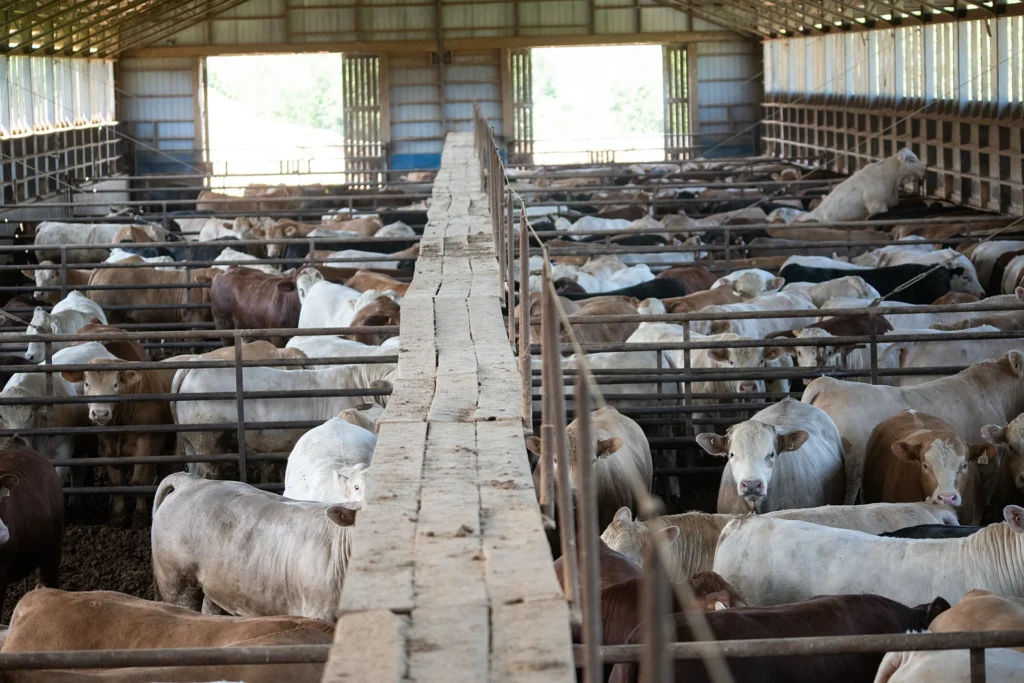
With fewer constraints and more export opportunities, feedlots – intensive cattle fattening systems – risk expanding even further.
These facilities not only inflict serious suffering on animals, such as the onset of respiratory and digestive diseases and high mortality rates (without even considering the enormous psychological and emotional stress), but also have major environmental and health consequences:
- they produce large quantities of waste contaminated with antibiotics, ammonia and heavy metals;
- they pollute surface waters and soils;
- they compromise the public health of nearby communities.
A symbolic and insufficient clause
Although the agreement contains some vague references to sustainability, it lacks a binding condition making tariff benefits contingent on compliance with European animal welfare standards.
The only concrete reference concerns eggs, a marginal product in trade relations with the Mercosur countries, which makes this clause, in practice, purely symbolic.
Yet European citizens are calling for far more: according to the Eurobarometer on animal welfare (2023), 84% of the population believes that imported products must comply with EU standards or, at the very least, be subject to clear and strict labelling. In Italy, the figure is even more clear-cut: 70% explicitly call for EU standards to be applied to imported products as well, while 86% want animal welfare rules to be strengthened and enforced without exception.
Deforestation and global impacts
Behind the trade in meat and feed lies, as has been well known for decades, a heavy environmental impact as well. The EU-Mercosur agreement would increase imports of beef, leather and soy for animal feed, further driving deforestation in unique ecosystems that are vital to our planet, such as the Cerrado, the Gran Chaco and the Pantanal.
According to Global Forest Watch, agriculture is the leading cause of deforestation globally, and beef is the most destructive factor: 36% of global agricultural deforestation is attributable to the expansion of pastureland. Between 2001 and 2015, more than 45 million hectares of forest (an area equivalent to Sweden) were cleared to make way for cattle farming.
Imports already through the roof
Current data already show very significant volumes:
- Beef: 58.3 million kg from Brazil, 52.7 million from Argentina, 33.6 million from Uruguay.
- Horse meat: 8.1 million kg from Argentina and 3 million from Uruguay.
- Chicken meat: 181 million kg from Brazil and 4.8 million from Argentina.
With the new agreement, these figures would be set to grow even further.
Our position
Animal Law Italia, together with Animal Equality Italia, CIWF Italia, Essere Animali, LAV and LNDC Animal Protection, calls on the Italian Government and the Members of the European Parliament elected in Italy to make a clear commitment: to reject the EU-Mercosur agreement until compliance with European animal welfare standards becomes a binding condition for its ratification.
The rush to finalise the agreement – driven in part by international tensions and the trade war launched by the Trump administration – cannot justify decisions that will have devastating consequences for animals, the environment and citizens.
“Mercosur would mean more deforestation, more animal suffering and unfair competition that would harm our producers. It is an unacceptable agreement and we call on the Italian Government to reject it without hesitation: we cannot sacrifice the environment, health and animal rights on the altar of a race-to-the-bottom in trade,” the associations declare.