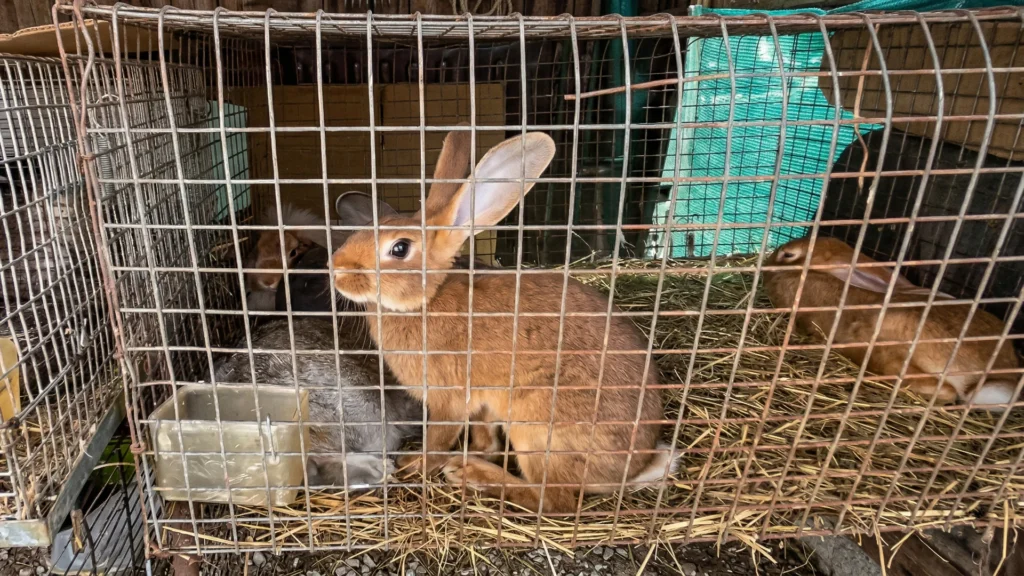
On 1 April 2026, the Municipal Council of Leinì (near Turin) unanimously approved the new Animal Welfare Regulation, which introduces a ban on the sale and keeping of live animals at weekly markets. Leinì thus becomes the first municipality in Piedmont and the twenty-first in Italy to adopt this measure, joining cities such as Milan, Rome, Monza, La Spezia, Bari and Lecce.
The decision was driven by the coalition “Non in vendita” (Not for Sale), whose public launch we are announcing today. Its members include Animal Law Italia, the association Animal, the Rete dei Santuari di Animali Liberi and the collective Zoout: four organisations united by the goal of putting an end to the sale of live animals at weekly markets across the country.
A new national campaign
With the launch of the coalition, noninvendita.it is also born — the portal where you can follow updates on the coalition’s activities, ongoing campaigns and results achieved.
The name of the coalition “Non in vendita” (Not for Sale) encapsulates a fundamental message: animals are not commodities. They should not be displayed in overcrowded cages, handled by passers-by, subjected to inappropriate noise and temperatures, or subjected to repeated stressful transport, only to end up in the hands of those who buy them on impulse without being aware of the responsibilities involved in caring for a living being.
Why this battle matters
The ambulant sale of live animals is a practice that raises serious, documented concerns on multiple fronts.
In terms of animal welfare, animals displayed at markets live in conditions of chronic suffering: overcrowded cages, lack of adequate shelter, constant exposure to noise and handling. Added to this is the stress of repeated transport and the forced proximity to dogs and other animals present at markets.
In terms of public health, the crowding together of animals of different species under severe stress facilitates the spread of zoonoses — diseases transmissible from animals to humans. The proximity of live animals to food stalls also creates concrete hygiene and health risks: contamination from faeces, urine and dust, with exposure to bacteria such as Salmonella and Campylobacter.
In terms of responsible purchasing, markets encourage impulse purchases that too often result in inadequate care or abandonment. Banning ambulant sales means promoting responsible adoption through shelters and associations, where people receive adequate information and can make informed choices.
The Leinì regulation
The new regulation approved by the Municipality establishes a broad framework for the protection of animals at the local level. It recognises owners as directly responsible for the physical and ethological care of animals, prohibits mistreatment and abandonment, regulates the conditions of keeping, transport and use in shows, and promotes civic education and collaboration with veterinary bodies and associations.
Approval was unanimous, following two amendments: the first clarified that the list of companion animals is illustrative and not exhaustive; the second introduced an exemption for events and exhibitions sponsored by the Municipality, provided they are carried out in compliance with animal welfare legislation.
Our comment
«The victory in Leinì is a first important milestone that points the way towards legislative change that can no longer be avoided» — declares Alessandro Ricciuti, president of Animal Law Italia — «Animal Law Italia was founded as an association of animal lawyers. Within this coalition, our role will be twofold: on the one hand, to support advocacy activities to bring this reality and the suffering of the animals who are its victims to light, with the aim of securing new bans; on the other — and above all — to provide constant legal oversight, pursuing legal action to rescue these animals and hold those who mistreat them accountable».
The next goal: Turin
The coalition now turns its attention to the Piedmontese regional capital. The request is clear: the Municipality of Turin should follow the example of Leinì and the more than twenty Italian cities that have already chosen to protect animals, public health and food safety by banning the sale of live animals at weekly markets.
Despite Piedmont’s Regional Law 19/2004 recognising animals’ right to live in conditions compatible with their biological and ethological characteristics, the reality of weekly markets tells a different story. It is time for Turin too to resolve this contradiction.