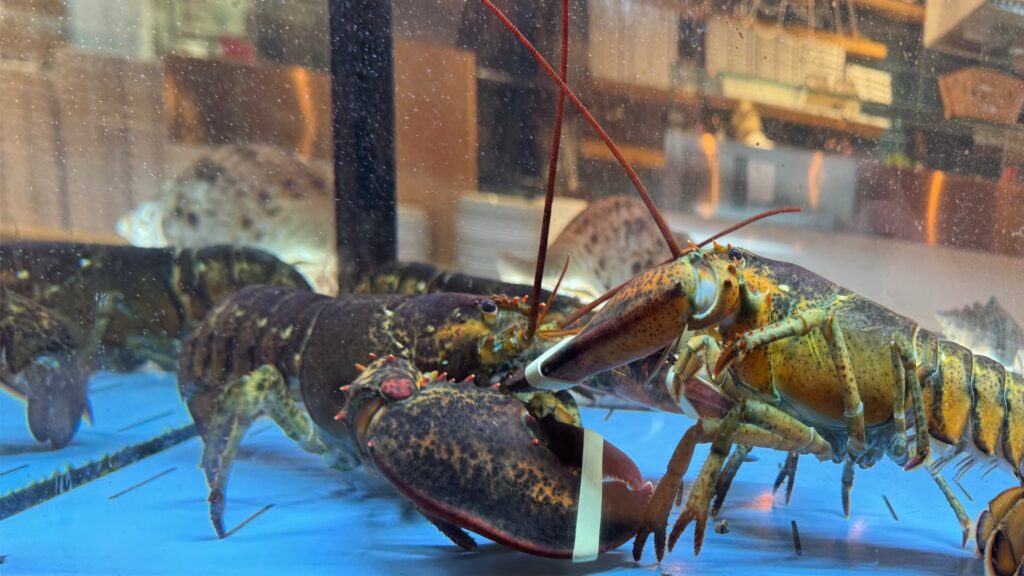
Keeping live lobsters, crayfish and crabs in direct contact with crushed ice, with their claws bound for extended periods, piled on top of one another or crammed into overcrowded tanks: these are practices still widespread in fish departments, including those of some large retail outlets. Through an informational communication and a formal invitation to adopt organisational measures, Animal Law Italia (ALI) has brought to the attention of company management a regulatory and case-law framework that directly affects the operation of those departments. The choice of certified email (PEC) serves to certify delivery and to formally notify companies of the existing legal framework on record.
Widespread practices may constitute a criminal offence
The Supreme Court of Cassation has clarified that keeping live crustaceans in direct contact with crushed ice or with their claws bound for extended periods while awaiting sale constitutes «a method productive of serious suffering»: conduct capable of constituting the offence under art. 727 of the Penal Code — keeping animals in conditions incompatible with their nature — and, in more serious cases, the crime of animal cruelty under art. 544-ter of the Penal Code (see, among others, judgment no. 30177/2017 of the Third Criminal Section).
In the same way, according to ALI, keeping live animals with excessive stacking, such as to cause crushing, also constitutes unjustified mistreatment, as does keeping them in visibly overcrowded tanks.
«This position is grounded in a finding now established in international scientific literature and recognised by case law — notes lawyer Alessandro Ricciuti, president of Animal Law Italia —: crustaceans are sentient beings, capable of experiencing pain, stress and thermal or osmotic shock when deprived of their natural habitat and subjected to temperatures incompatible with their physiology.»
Liability extends to the top
Criminal liability does not end with the employee who physically carries out the conduct. Under art. 40, paragraph 2, of the Penal Code, failing to prevent an event that one has a legal obligation to prevent is equivalent to causing it: senior officers and company managers who hold a position of guarantee, and who have failed to adopt adequate training and organisational measures to prevent offences, may be held liable as accomplices. The failure to provide staff training programmes and adequate operational protocols thus becomes a relevant factor in assessing the organisational diligence of those at the top.
What makes the issue immediately pressing is the legislative turning point of 2025. With Law no. 82 of 6 June 2025, in force from 1 July 2025, the new art. 25-undevicies, entitled «Crimes against animals», was introduced into Legislative Decree 231/2001, inserting animal cruelty (art. 544-ter of the Penal Code) for the first time among the predicate offences for corporate administrative liability. The consequences are concrete: if the offence is committed by a senior officer or an employee in the interest or to the advantage of the company, the entity is liable to a financial penalty of up to 500 units and to disqualification sanctions of up to 2 years — including prohibition from carrying on business, suspension or revocation of authorisations and licences, a ban on contracting with public authorities, and exclusion from public grants and funding. Companies trading in live animals, a category that includes large-scale retail operators managing fish counters, are among the most exposed. The only available defence is proof of having adopted, prior to the offence, an Organisation and Management Model (MOG) specifically designed to prevent such offences: a model that is absent, generic or lacking in safeguards for the management of live animals does not permit reliance on that defence.
What we are asking for
The communication, however peremptory, is framed as an invitation to come into compliance along three lines: the training and informing of fish-counter staff, store managers and logistics managers regarding legal obligations and case-law developments; the adoption of operational protocols that ensure conditions of keeping compatible with the ethological characteristics of the animals, minimising all avoidable suffering; and the review and updating of Organisation and Management Models in light of Law 82/2025. ALI has asked the companies to communicate within 30 days of receipt the measures already adopted or being adopted, and has made itself available for technical dialogue. The objective, beyond pressing for concrete change, is clear: from now on, no one will be able to hide behind a generic «we didn’t know».
The coalition
The initiative is part of the work of the On the Side of Crustaceans coalition, which brings together, in addition to Animal Law Italia, Animal Equality Italia, CIWF Italia, ENPA, Essere Animali, LAV, LEAL, LNDC and OIPA. The shared objective is the full recognition of decapod crustaceans as sentient beings, in line with the Treaty of Lisbon, which commits Member States to pay «full regard to the welfare requirements of animals as sentient beings».
On the regulatory front, the coalition calls for the definitive end of storage on ice, through a direct ban on the practice; a ban on boiling animals while still alive; and a ban on the direct sale of live crustaceans to consumers, including through online channels. These are demands that enjoy broad public support: according to a survey commissioned by ALI from Youtrend, the majority of respondents believe it is necessary for new legal protections to be guaranteed for these animals. In particular, 64% of respondents would ban keeping them in tanks unsuited to their vital needs, while 61% said they were opposed to cooking them while still alive.