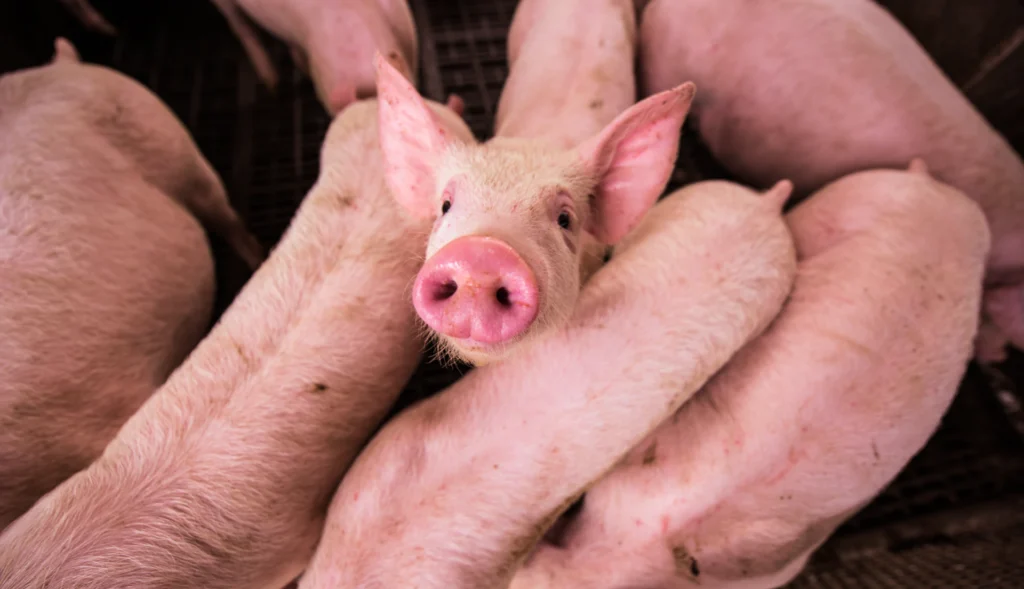
When the European Union signs a trade agreement, it can seem like something far removed from our daily lives. And yet it is precisely in those texts that decisions are made about what will end up on our tables — and under what conditions the animals from which those products come will have been raised.
The good news is that animal welfare is beginning to make its way into European trade agreements. The bad news is that it does so inconsistently: in some agreements it matters, in others it is almost entirely ignored. As the EU is revising its own animal welfare legislation, a precious window is opening to apply European standards to all products entering its market, from wherever in the world they come.
Australia: proof that it can be done
The EU-Australia agreement introduces animal welfare conditions tied to preferential access for key agricultural products: beef, sheepmeat, and eggs in shell.
For beef, access to the European market is linked to production requirements that favour pasture-based systems. Preferences for Australian sheepmeat exports are entirely tied to pasture-raised farming. And eggs in shell can benefit from tariff liberalisation only if they comply with the European directive on laying hens, which bans conventional battery cages.
It is not a perfect agreement. But it demonstrates one simple and decisive thing: animal welfare conditions can be written into trade agreements. Where there is a will, there is a way.
Mercosur: a missed opportunity
The EU-Mercosur agreement tells the exact opposite story. It contains very few provisions on animal welfare, and the only significant limitation once again concerns eggs in shell: just 36 tonnes of trade in 2025, a negligible quota of the agricultural trade envisaged by the agreement.
The bulk of trade instead concerns beef and poultry meat — precisely the products for which the agreement does not include requirements equivalent to European standards. This is far from a minor detail, in light of recent investigations that have documented serious shortcomings in the intensive feedlot farms supplying the EU market: overcrowding, heat stress, restricted movement, poor sanitary conditions, and health problems linked to feeding practices.
The contradiction becomes clear when looking at the EU-New Zealand agreement, where feedlot-produced beef is explicitly excluded from preferential access on sustainability grounds. Why are those same production methods considered incompatible with one agreement and perfectly acceptable in another?
The full investigation by Animal Welfare Foundation, conducted across 21 cattle farms authorised to export to the EU in Uruguay, Argentina and Brazil, is documented in the report Stop Cruel Imports.
Mexico: a first step that remained on paper
The most recent agreement, with Mexico, contains the first standalone chapter on animal welfare ever included in an EU trade agreement: at the time, an important step forward.
The problem is that the agreement does not make preferential access conditional on compliance with animal welfare standards. And the fact that trade in animal products is currently limited is no good excuse: trade agreements are designed to last over time and to shape future flows. As it stands, the agreement misses the opportunity to ensure that any possible increase in trade takes place with respect for animal welfare.
The EU review: an opportunity not to be missed
These agreements are arriving precisely as the EU is revising its animal welfare legislation. This is the opportunity to enshrine a principle as simple as it is just: European standards must apply to all products placed on the EU market, regardless of their origin.
This is what we call mirror measures (or mirror clauses): making access to the European market conditional on compliance with standards at least equivalent to those imposed on European producers. A concrete tool, already partially applied by the EU and fully compatible with the rules of the World Trade Organization.
Without strong import requirements, we will continue to allow products onto our tables that were obtained under standards that would be illegal in Europe — in open contradiction with what citizens are calling for. Mirror measures, by contrast, protect three things at once: animal welfare, European producers who already bear the costs of stricter rules, and consumers’ right not to unwittingly fund suffering.
They can also act as a lever: a tool to accompany partner countries towards the objectives of future European legislation, rather than leaving them behind.
This is why clear and enforceable animal welfare requirements for imports must be at the heart of the upcoming review. Europe has already shown it knows how to use its commercial attractiveness to raise standards across the rest of the world. The question is whether it will have the political will to do so for animals as well.
What you can do
Animal Law Italia is on the front line in calling on European institutions to introduce mirror measures. Support the campaign and sign to stop cruel imports at stop-mercosur.it.