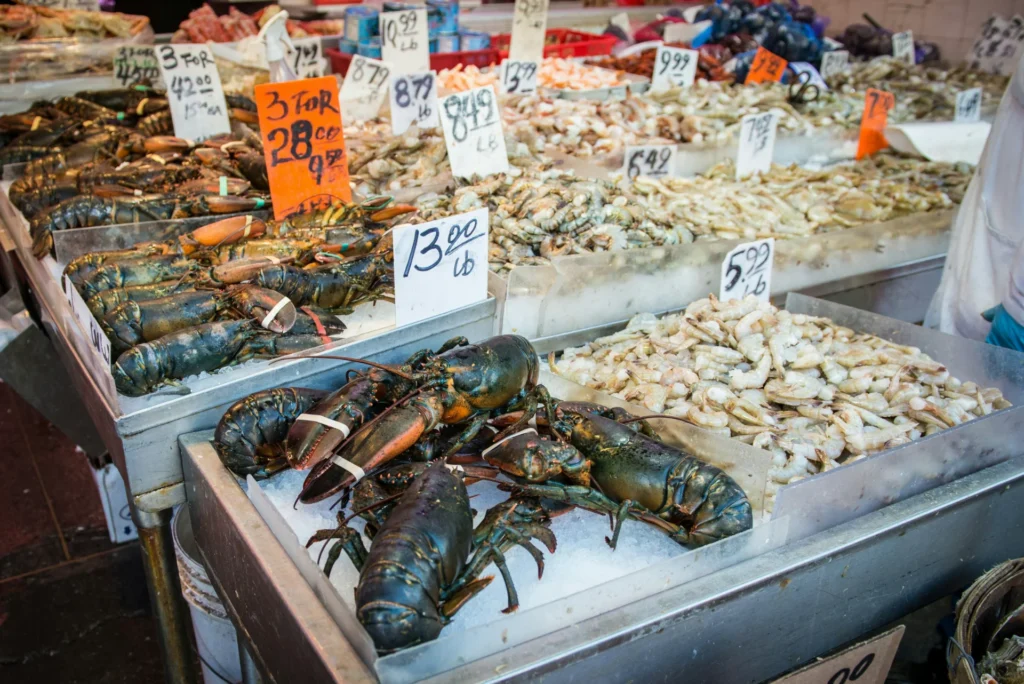
In the window of any restaurant, in any city, sea bass, sea bream, prawns, lobsters and crabs are put on display. Passers-by on the pavement are drawn to the display with mixed reactions ranging from “those are the carcasses of poor animals” to “they certainly have really fresh fish here”, but after a moment the passer-by, who until just before was fairly distracted, notices a movement in the window — almost imperceptible. They try to focus properly and realise that, in fact, the lobster lying on the ice with its claws tied is still alive, it is moving. What the unsuspecting passer-by does not yet know is that this lobster, before ending up in the window of any restaurant in any city, travelled from very, very far away — specifically from the depths of the Atlantic Ocean, from those deep waters that wash the coasts of Maine, one of the American states where it was caught a full eight days earlier.
“But eight days ago? How can it still be alive?” the unsuspecting passer-by would wonder, if they had knowledge of this information. From this question, from the very essence of this question, the coalition “On the Side of Crustaceans” was built.
Crustaceans are in fact highly resilient and can live out of water for more or less long periods, because they have the ability to synthesise oxygen from the surrounding air when kept in conditions of high humidity at a controlled temperature. In this way, travelling by air, they can reach tables on the other side of the globe, or any other part of the globe. Agonising for days, because we are talking about marine creatures that live in the depths of seas and oceans and are not farmed, but come exclusively from fishing activities.
Decapod crustaceans, like the lobster at the centre of this story, are living beings that science has established to be sentient creatures, capable of perceiving pain and negative stimuli from the adverse conditions they are forced to endure. In short, they “suffer” during these journeys, and even more so when they are displayed and kept directly on ice. Suffering that can be avoided both by not consuming them and by transporting the bodies of animals slaughtered at the point of capture — and this is the ultimate goal that the coalition “On the Side of Crustaceans” aims to achieve.
The law considers them food first and living beings second, and for this reason they can be subjected to the journeys we have described. However, there are forms of suffering that can be avoided, such as keeping them in direct contact with ice and with their claws tied, as confirmed by a ruling by the Court of Cassation in 2017 which convicted a restaurant owner for animal cruelty. So, what could our passer-by do to prevent this suffering? They should call the Local Police and ask them to intervene by sanctioning the responsible party, also because, by now, many municipal regulations prohibit the display of live crustaceans on ice. Don’t walk past, don’t turn a blind eye — because putting an end to a practice that is unacceptable depends on your sensitivity: live crustaceans must no longer be sold. Share the website of the coalition “On the Side of Crustaceans” and spread the material we have produced on social media to help raise awareness and information. To bring about change, sometimes a single click is enough!