Today we publish our new scientific report entitled “Maintenance standards for lobsters and crayfish in aquarium tanks, with specific guidelines on stocking density, shelters, lighting and claw binding“. This is the second scientific study produced by ALI in support of our work of filing criminals report for mistreatment of these animals across Italy. This document aims to examine the main issues related to the keeping of lobsters and crayfish in aquarium tanks, providing a solid basis for denouncing practices that cause suffering to these animals, such as exposure to direct light, claw binding and overcrowding.
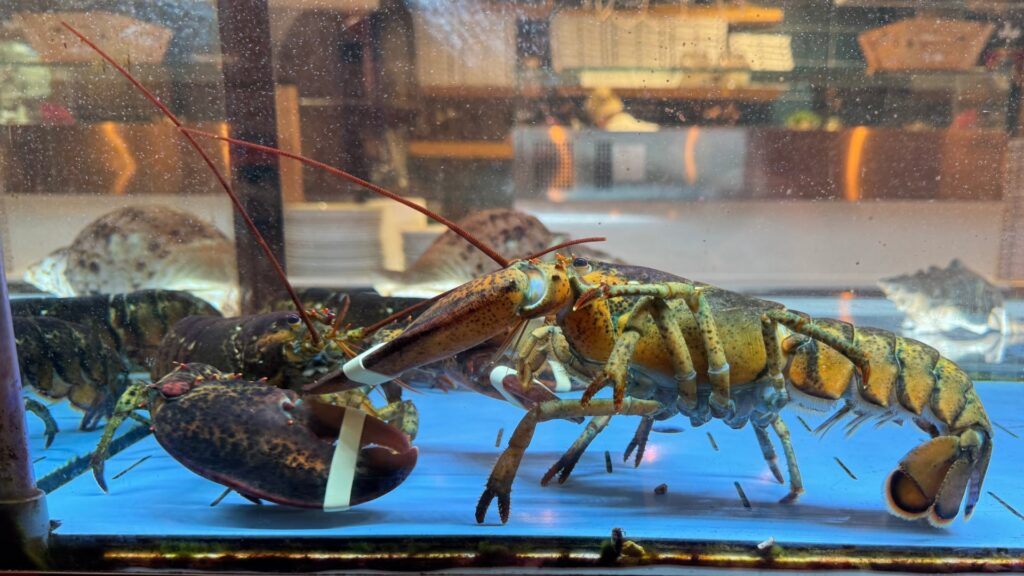
In Italy, several species of decapod crustaceans — ten-legged crustaceans such as lobsters, crayfish and crabs — are frequently kept alive in aquarium tanks inside restaurants, fishmongers and supermarkets, on the grounds that this practice guarantees their freshness. However, in these settings such animals are often kept in highly inadequate conditions compared to their natural environments. Many of them, being solitary and territorial, need shelters in which to hide away from the light, preferring to live in darkness in the wild. Contrary to this, in such commercial establishments they are routinely kept without shelters, under direct light and confined in spaces with high stocking density, a situation that can significantly compromise their health and welfare.


Examples of lobsters and crayfish kept in overcrowded conditions, without shelters, in full light and with the claws bound in the case of crayfish.
This report aims to analyse the detention conditions most commonly adopted for these animals in supermarkets, restaurants and fishmongers, assessing their adequacy in relation to their welfare and ethological requirements and drawing on the available scientific literature. Given that the majority of decapod crustaceans kept in aquarium tanks in Italy are lobsters and crayfish, the research has focused on these two groups, represented mainly by three species: the European spiny lobster (Palinurus elephas), the European lobster (Homarus gammarus) and the American lobster (Homarus americanus). After a description of the biology, including the ethological aspects of crayfish and lobsters, the report explores in detail the keeping conditions of these two groups of animals (crayfish and lobsters) and their effects on the animals’ welfare. The main conditions examined in the report include stocking density, light exposure, availability of shelters and claw binding in crayfish.
The scientific opinion recommends that decapod crustaceans kept for food purposes should always have access to shelters and dark areas. Crayfish and lobsters are primarily nocturnal animals, emerging from their shelters to search for food at nightfall and returning to them as light increases. This highlights their need to avoid strong illumination. Therefore, these animals should not be exposed to intense lighting above their tanks, sudden changes in light levels should be avoided, and aquarium tanks should be equipped with shelters where the animals can take refuge. The practice of binding the claws of crayfish, furthermore, disregards their physiological and ethological needs and therefore should no longer be practised.
The document nevertheless concludes that, on a practical level, it would be desirable for these animals to no longer be sold alive in supermarkets, restaurants and fishmongers, in order to respect their welfare and their ethological needs, which could hardly be adequately met in such commercial contexts.
We at Animal Law Italia hope that this new scientific contribution may facilitate the introduction of a legislative solution in Italy, in the form of a national regulation ensuring an adequate level of welfare protection for decapod crustaceans at all stages of the production chain, from fishing to transport, from keeping to slaughter. Through the On the Side of Crustaceans campaign, ALI intends to raise awareness among the competent authorities so that specific regulations are issued to guarantee the protection of these animals in Italy and in Europe.