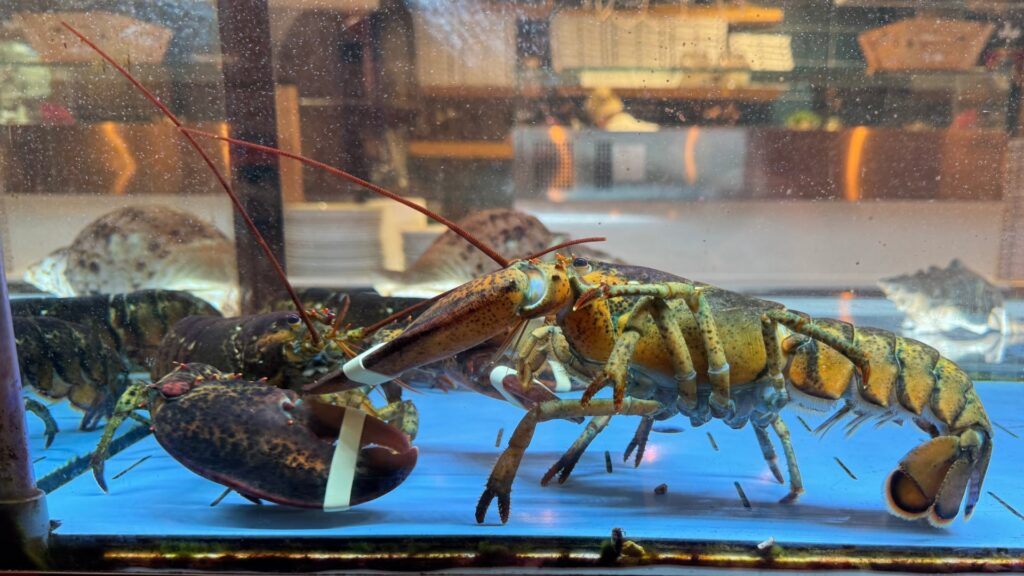
2024 closes with a new step forward in favour of crustaceans, following the issuance of fines against a fish restaurant and a Metro supermarket by the prefectural zoophilic guards. The intervention became necessary because the commercial establishments involved were keeping crustaceans in violation of the applicable animal protection regulations.
At the premises, in fact, the lobsters and spiny lobsters intended for food consumption were being kept with their claws permanently bound.
The regulatory basis that allowed the issuance of the fine is to be found in the Animal Protection Regulation of the Municipality of Rome (Council Resolution no. 275/2005), which clearly provides, in Article 52, for the prohibition of permanently binding the claws of crustaceans. Furthermore, the Regulation references in its preamble various legal sources, including Article 544 ter and Article 727 of the Italian Criminal Code.
The first provision, entitled animal cruelty, establishes, in particular, that anyone who subjects an animal to abuse or to behaviour or exertion unbearable given its ethological characteristics is punishable by imprisonment of three to eighteen months or a fine of between 5,000 and 30,000 euros. The second provision, in its second paragraph, provides for a sentence of arrest of up to one year or a fine of between 1,000 and 10,000 euros for anyone who keeps animals in conditions incompatible with their nature and productive of serious suffering.
It is therefore interesting to note how the law considers it mistreatment to subject animals to inadequate conditions with regard to the nature and characteristics of the animal — a very broad definition applicable to all species.
As also specified in other articles already published, the protection of crustaceans is particularly lacking and largely left to municipal regulations and jurisprudential interpretations; for this reason, such a broad definition of the concept of mistreatment is particularly necessary.
Other practices considered contrary to the welfare of this animal species include keeping them on ice and in overcrowded tanks or exposed to light, as shown by several scientific studies.
The fines amounting to 1,800 euros were issued, following the inspections, by the prefectural zoophilic guards of the association Earth ODV. Associations and zoophilic guards are generally responsible, throughout the national territory, for promoting a proper civic sense towards animals and their legal protection.
In conclusion, the existence of municipal provisions on the matter represents a good starting point for continuing the fight for the protection of crustaceans; however, greater awareness among the operators who are responsible for their implementation is needed.