The Italian Constitution establishes that “the law of the State regulates the methods and forms of protection of animals”1 while the Penal Code defines the violation of this non-derogable principle as “mistreatment” occurring when “anyone, out of cruelty or without necessity, causes injury to an animal or subjects it to torture or to behaviour or to fatigue or to work unbearable for its ethological characteristics”2. The duty to adhere to scientific evidence regarding the species-specific needs of non-human individuals officially delegitimises their reduction to mere objects, amorphous entities devoid of sensitivity, interests and needs. Among the countless sacrificial victims of alimentary “necessity” we find the Decapoda, a broad order of Crustaceans comprising 233 families, 2,725 genera and more than 17,000 species. In particular, on the tables of Italian families set for Christmas celebrations, the flesh of specimens from three species belonging to the suborder Pleocyemata has been served above all: the lobster, the Norway lobster and the spider crab.
The lobster (Homarus gammarus), inhabitant of rocky seabeds
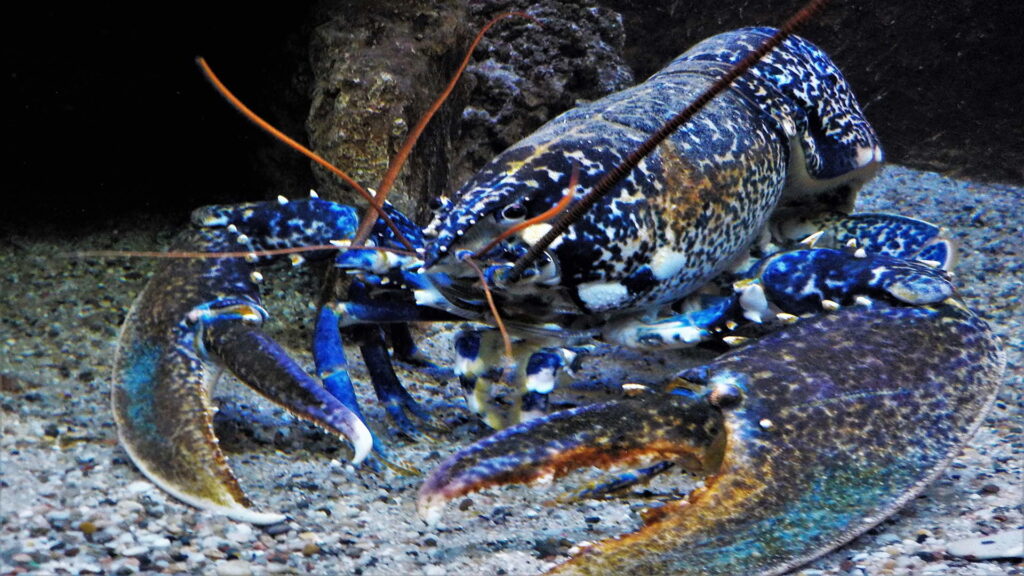
The lobster (Homarus gammarus), also known as the European lobster, sea wolf or sea elephant, is a species included in the family Nephropidae of the infraorder Astacidea, distributed along the shores of the eastern Atlantic Ocean, from north-west Norway to Morocco, of the northern Mediterranean Sea and the northern Black Sea. Distinguished by their brown, sometimes bluish colouring (which is why they are also called “blue European lobsters”), dotted with yellow patches, adult specimens measure on average between 30 and 50 centimetres and are equipped with a massive tail, two pairs of antennae, eight locomotive limbs and two front legs bearing two large asymmetrical claws.
These Decapods inhabit rocky seabeds, from the surface down to 50 metres, in some cases venturing as deep as 150. During the day they rest in crevices, cavities or burrows, while they become active at night, patrolling their territory to drive away intruders and to seek food in the surrounding area. The lobster preys mainly on other crustaceans, molluscs, sea urchins and other small invertebrates, but its generalist diet also includes animal remains and plant matter. In early summer mating takes place, culminating the following year in the laying of tens of thousands of eggs, which are protected and carried under the mother’s tail for approximately eleven months, until the tiny transparent planktonic larvae scatter into the open sea, awaiting the three metamorphoses needed to acquire their adult form and respective habits.
The Norway lobster (Nephrops norvegicus), lover of mud
The eastern stretch of the Atlantic Ocean and the west-central area of the Mediterranean Sea are home to another Nephropid: the Norway lobster (Nephrops norvegicus). These crustaceans possess a slender body of pinkish-white or reddish colouring, measuring from 8 to 24 centimetres including the tail appendage, joined to two pairs of antennae and, like all other Decapods, to ten limbs: the front pair of pereiopods is long and robust, with quadrangular claws, while the remaining thoracic appendages are slender, with small claws on the second and third pair.
Norway lobsters populate the slopes and escarpments of coastlines, digging their burrows in muddy sediments at depths of 20 to 800 metres. Much like lobsters, they are sedentary, nocturnal organisms that prey on other small invertebrates, including crustaceans and worms, without shunning necrophagy, feasting on the detritus and carcasses they come across. The biological cycle is also very similar to that of their “cousin”: females lay thousands of eggs around July, after which they carry them under their tail for approximately nine months, when the pelagic larvae will hatch, destined to undergo three moults before displaying the anatomy and behaviour of their parents.
The spider crab (Maja squinado), master of disguise
The spider crab (Maja squinado), also known as the spiny spider crab, is a species belonging to the family Majidae, a portion of the broad group of crabs, that is, Decapod Crustaceans belonging to the infraorder Brachyura. Populations are established along the coasts of the entire Mediterranean Sea and the eastern Atlantic Ocean, from Denmark to Angola. Members of the species have a spiny brown-orange or reddish carapace, up to 22 centimetres long and up to 18 centimetres wide, from which extend ten long, slender limbs — eight used for locomotion while the pair closest to the pointed cephalic extremity bears two small claws.
These crabs live among the algae of rocky or sandy marine substrates from the surface down to 200 metres, but can also settle at greater depths, blending in with their underwater habitat thanks to their rough and bristly carapace, often covered in sea lettuce. Hidden among inlets, rocks and vegetation, these organisms protect themselves from predators while scanning the seabed to feed on algae, bivalves, larvae, worms and small fish. Unlike the two species mentioned above, a spider crab can reproduce up to four times a year: mating is preceded by a courtship ritual characterised by olfactory and tactile stimulation and is followed by egg-laying, with the eggs being guarded and carried under the mother’s abdomen. After hatching, thousands of young individuals in the larval stage known as zoea pour into the surface waters and then, generally, descend towards the seabed as sexual maturity arrives, continuing to undergo moults at regular intervals to shed their old exoskeleton and form one suited to the increased dimensions of their body.
Not just food: decapod crustaceans are sentient beings
All three species are caught using traps, as their flesh is highly prized in cooking, especially lobsters and Norway lobsters, whose value is reflected in their hefty price. However, intensive fishing and the destruction of habitats caused by pollution have brought about a population decline that the international community has long been attempting to remedy in order to safeguard marine biodiversity. In 1976 in Barcelona, the Convention for the Protection of the Mediterranean Sea Against Pollution included the lobster and the spider crab in the list of protected species of the SPA/BIO Protocol, and both likewise appear in the list of Annex III of the Convention on the Conservation of European Wildlife and Natural Habitats, adopted in Berne in 1979. More recently, from 2013 and 2015 respectively, the lobster and the Norway lobster have been listed on the Red List of the International Union for Conservation of Nature, although they fall within the least concern category, meaning they are among the species at minimum risk of extinction in the short term.
Beyond concerns regarding the protection of the species and the ecosystem, what matters to an animal rights advocate is the consideration and treatment to which individual animals are subjected in human society. Of paramount importance is therefore the report Review of the Evidence of Sentience in Cephalopod Molluscs and Decapod Crustaceans 3 published in November 2021 by the research group led by Professor Jonathan Birch of the London School of Economics and Political Science. The comparison of studies conducted on these organisms certifies the presence of pain receptors and brain areas dedicated to formulating strategies and countermeasures in response to injury and threats, thus debunking their reducibility to an automaton driven by mere automatic reflexes. From the complex architecture and functioning of the nervous system present in Decapods, but also in other marine invertebrates such as the octopus, the squid and the cuttlefish, their sentience can be inferred — that is, the capacity shared by the great majority of the animal kingdom to experience sensations of pain and pleasure, of fulfilment and distress, and to use them as a compass to navigate the world.
Notes
- Constitution, Fundamental Principles, Article 9, Paragraph 3 (amended by Article 1, Paragraph 1, Constitutional Law of 11 February 2022, no. 1). ↩
- Penal Code, Book Two, Title IX bis, Article 544 ter (introduced by Article 1, Law of 20 July 2004, no. 189). ↩
- J. Birch, C. Burn, A. Schnell, H. Browning, A. Crump, Review of the Evidence of Sentience in Cephalopod Molluscs and Decapod Crustaceans, LSE Enterprise Ltd, London, 2021. ↩