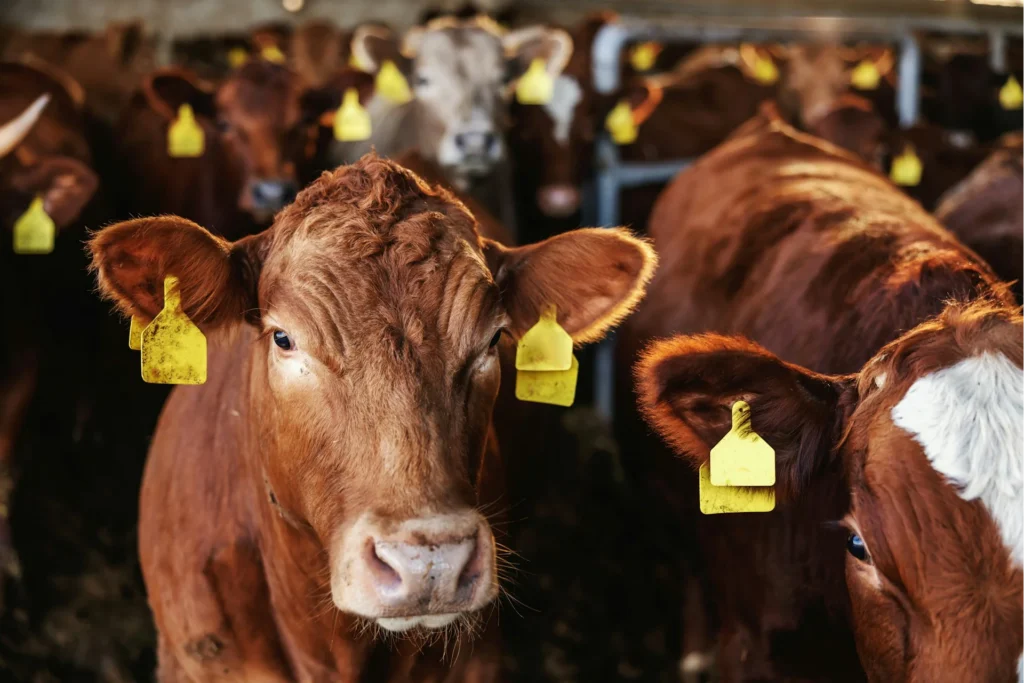
At this point in history the European Union seems poised to revise its outdated animal welfare legislation but, at the same time, the provisional entry into force, on 1 May, of the trade agreement with Mercosur is allowing products obtained in the countries of that region without equivalent rules to enter the EU market, in effect offshoring animal suffering beyond its borders.
This mechanism creates an ethical and economic short circuit that shifts the impact of cruelty and environmental devastation onto third countries, misleading consumers and exposing the European food industry itself to serious weaknesses.
Regulatory hypocrisy: moving suffering instead of ending it
The recent policy brief by Eurogroup for Animals highlights how the absence of import requirements equivalent to the criteria imposed by EU legislation creates a real risk of shifting responsibility for animal welfare to non-EU countries where protection is weaker or even non-existent.
Instead of gradually eliminating the cruellest farming practices within the European food system, the lack of mirror clauses encourages them to be relocated outside the Union’s borders.
Against this drive to offshore cruelty, European imports of animal products continue to rise significantly:
- Imports of eggs and egg products have grown by 253% in recent years.
- Imports of beef have risen by 55%, driven mainly by shipments from Brazil.
- Around 25% of the chicken breast eaten in the EU now comes from third countries.
Without uniform import conditions, foreign producers enjoy an unfair competitive advantage on costs, accelerating the relocation of production and undermining the efforts of European farmers who are required to comply with stricter rules.
Outsourced cruelty in South American feedlots
What on paper looks like a mere trade distortion translates on the ground into extreme suffering for millions of animals. The investigations carried out by Animal Welfare Foundation (AWF) between August 2025 and March 2026 on 21 factory farms in Brazil, Argentina and Uruguay authorised to export to the EU show the harsh reality of imported meat:
- Cattle crammed into open-air feedlots, without adequate shade or clean drinking water.
- Animals forced in the winter months to lie in mud among accumulated excrement and contaminated water.
- Severely malnourished, lame, injured or sick animals left in the pens together with cattle that had already died.
In 2024 alone, the EU imported around 393,000 tonnes of beef (equivalent to about 2.9 million animals), half of it from the Mercosur countries.
This system entrenches a structural double standard: the EU recognises animals as sentient beings in Article 13 TFEU and imposes Directive 98/58/EC on minimum internal standards, but in practice sets these protections aside in free trade agreements such as the EU–Mercosur agreement.
Invisible to consumers, and the impact on Made in Italy
Offshored suffering enters the daily lives of EU citizens almost invisibly, including through catering and the food processing industry, sectors in which labelling of origin and farming method is not mandatory, so consumers end up unwittingly buying food produced to low ethical standards.
An emblematic case of this contradiction concerns Bresaola della Valtellina PGI, a sector worth 502 million euros in retail value. Although it is a symbol of Italian excellence, the protection consortium has confirmed that 82% of bresaola is made with South American meat, of which 60% comes from Brazil (using frozen imported zebu meat).
When the EU Commission suspended meat imports from Brazil from 3 September because of insufficient guarantees on laboratory testing linked to the use of antibiotics and antimicrobials banned in the EU, the Italian supply chain went into crisis, immediately losing 25% of its raw material and facing a 15% price rise. This suspension showed how dependence on foreign supply chains built on relocated production exposes Italian industry to serious health and economic vulnerabilities, as well as indirectly financing deforestation in the Amazon.
Mirror measures: ending double standards
It would therefore be essential for mirror measures to be included in the revision of EU animal welfare legislation.
This mechanism makes access to the single market conditional on compliance with animal welfare standards equivalent to those of the EU, verifiable through objective and measurable indicators.
It is European citizens themselves who are making this demand:
- 91% of Europeans consider it essential to protect the welfare of farmed animals.
- 84% say that imported products must comply with EU animal welfare rules or carry rigorous labelling.
- 88% of citizens in the Eurobarometer survey demand that agricultural imports meet EU environmental and animal welfare standards in order to access the market.
Introducing binding import clauses is the only way to prevent European reforms from amounting to a mere transfer of cruelty outside the EU, thereby guaranteeing real protection for animals and transparency for consumers.