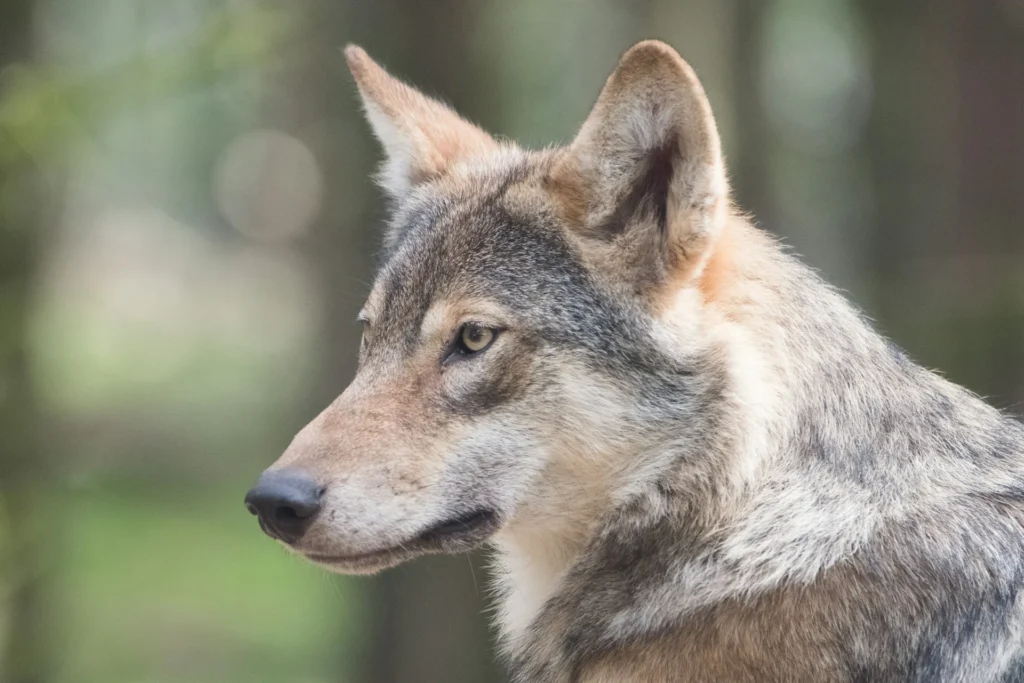
On 4 and 15 August, in Noicattaro, in the province of Bari, three six-year-old children were attacked in a municipal park. DNA analysis of samples taken from one child’s clothing confirmed that the animal was a young male Apennine wolf. Camera traps set up by the task force coordinated by the Prefecture then identified three wolves in the surrounding countryside; the Region authorised the capture of the animal believed to be responsible.
For anyone working to protect animals, this is the hard case, and the most immediate temptation is to play it down. We will not. Those children really were bitten, their families really were frightened, and an association that asked for this to be ignored would lose — rightly — all credibility at the very moment it demands rigour from others.
The point is a different one, and it is precisely a legal one: a general rule does not follow from a rare and isolated event. And the general rule being written in these months does not stem from events like this at all.
Two mirror-image mistakes
A few weeks ago we published on this blog Ermanno Giudici’s reconstruction of an incident in Camaiore: a dog killed by a wolf, which in the accounts of many news outlets became a wolf that had allegedly tried to attack a little girl during a family barbecue. Of the barbecue, the little girl and the bystanders there was no trace: there was an unfenced garden at the edge of a wood, and a dog.
Camaiore and Noicattaro are the two extremes of the same problem. In the first case an attack that never happened was invented; in the second, these incidents will be used as an argument to prove an emergency that does not exist. Both mistakes stem from the same habit: using the single incident as proof of a nature, rather than as a fact to be explained.
The Noicattaro case, once explained, tells us something very specific. A young dispersing wolf, probably separated from its pack, that frequents urban parks and approaches people is not a wolf behaving like a wolf: it is a wolf that has lost its wariness. The factor that the scientific literature most consistently associates with this loss is the availability of food of human origin.
Which makes the first measure adopted by the municipality — a ban on leaving food unattended outdoors — technically correct. The problem was how it was written.
The grammar of emergency
The emergency ordinances (“ordinanze contingibili e urgenti”) adopted by the mayor of Noicattaro, extended several times, contain — alongside the night-time closure of parks — a broadly worded ban: no distributing pet food outside homes. A provision framed in this way risked sweeping away the feeding of cat colonies, which is a lawful and protected activity.
Through our Rete Felina we asked the municipality for clarification, and obtained it quickly and in a spirit of cooperation: the ban targets food left unattended, not the feeding of colonies. One point could still be improved, because the reply limits protection to “registered” colonies, whereas the law does not: Article 13(1) of Apulia Regional Law no. 2/2020 provides that free-living cats “are protected and anyone is prohibited from mistreating them or removing them from their habitat”, and Article 2(7) of Law no. 281/1991 prohibits anyone from mistreating them. Registration matters for other purposes, not as a condition of protection.
And this is where the discussion returns to the law. An emergency ordinance can do a great deal, but not everything: it must remain closely tied to the emergency that justifies it. Extending the ban beyond what that emergency requires, without an investigation that accounts for it, is not only questionable as a matter of principle but is a defect in the act, open to challenge for lack of proportionality. When animals are involved, disproportion is all too often treated as a question of sensitivity, whereas it is also a question of lawfulness.
From the news to the law
Meanwhile, and on an entirely different level, the wolf’s protection regime has changed.
On 6 December 2024 the Standing Committee of the Bern Convention approved moving the wolf from Appendix II to Appendix III — from strictly protected to protected species — with effect from 7 March 2025. This was followed by Directive (EU) 2025/1237 of 17 June 2025, in force since 14 July, which deletes the entry Canis lupus from Annex IV of the Habitats Directive and lists it in Annex V. In Italy, transposition goes through Article 7 of Law no. 36 of 17 March 2026 (the 2025 European Delegation Law): the EU transposition deadline is 15 January 2027, but under the mechanism of Article 31 of Law no. 234/2012 the legislative decree must be adopted four months earlier. We are, in other words, only a few weeks away.
Even under the previous regime, Article 16 of the Habitats Directive allowed derogations “in the interests of public health and public safety”, and Law no. 157/1992 already governs action against the individual problem animal. What the downgrading changes is not the management of the dangerous individual, but the general framework: it opens up the possibility of regional culling plans based on numbers, as already happens with bears in Trentino.
However, the downgrading was not decided on the basis of data. Along the path from the Commission’s proposal to the directive, there was no scientific review of the species’ conservation status. On 13 December 2024 the IUCN publicly observed that the same Large Carnivore Initiative for Europe report cited in 2023 to oppose the downgrading was now being cited to justify it, in the absence of significant changes in populations or threats, and called for science to take priority over political pressure.
It should be added, in fairness, that the downgrading imposes nothing. The wolf remains listed in Annex II, so the Special Areas of Conservation remain; and Article 14 of the Habitats Directive provides that, for Annex V species, Member States shall — if they deem it necessary in the light of the surveillance under Article 11 — take measures to ensure that the taking and exploitation “is compatible with their being maintained at a favourable conservation status”, while Article 15 continues to prohibit non-selective means. The downgrading therefore opens up an option but does not create an obligation to exercise it.
Wildlife as property, not as a subject
That this is an uphill battle, however, depends on the very way in which wild animals enter our legal system.
Article 1 of Law no. 157/1992 says so unambiguously: “Wildlife is inalienable property of the State and is protected in the interest of the national and international community”. In 1992 this was progress, because it removed wildlife from the logic of res nullius. But the category remains one of property: the wolf is an asset, and its protection serves an interest that belongs to us.
The 2022 constitutional reform added to Article 9 the protection of the environment, biodiversity and ecosystems “also in the interest of future generations”, providing that “the law of the State shall regulate the ways and forms of protecting animals”: a reservation of legislative power first exercised with Law no. 82/2025, but which, as far as wildlife is concerned, is still waiting to be given substance. And Article 13 TFEU, the provision that recognises animals as sentient beings, binds the Union and the Member States “in formulating and implementing the Union’s agriculture, fisheries, transport, internal market, research and technological development and space policies”. The list is exhaustive, and nature conservation is not on it: the EU’s recognition of sentience, as it is written, does not reach the wolf.
When the exception becomes the rule
Finally, there is bill no. 1552, approved by the Senate on 23 June 2026 and now before the Chamber of Deputies, which rewrites Law no. 157/1992: hunting extended to areas currently off limits, more hunting days and longer seasons, night-vision devices for selective culling, looser rules on live decoys, hunters involved in wildlife control and — above all — ISPRA’s opinion downgraded from binding to advisory. It is the same movement taken to its conclusion: reducing technical and scientific constraints in order to widen management discretion. It is no surprise that the European Commission has already sent a warning letter, or that the text’s compatibility with the new Article 9 of the Constitution is being debated.