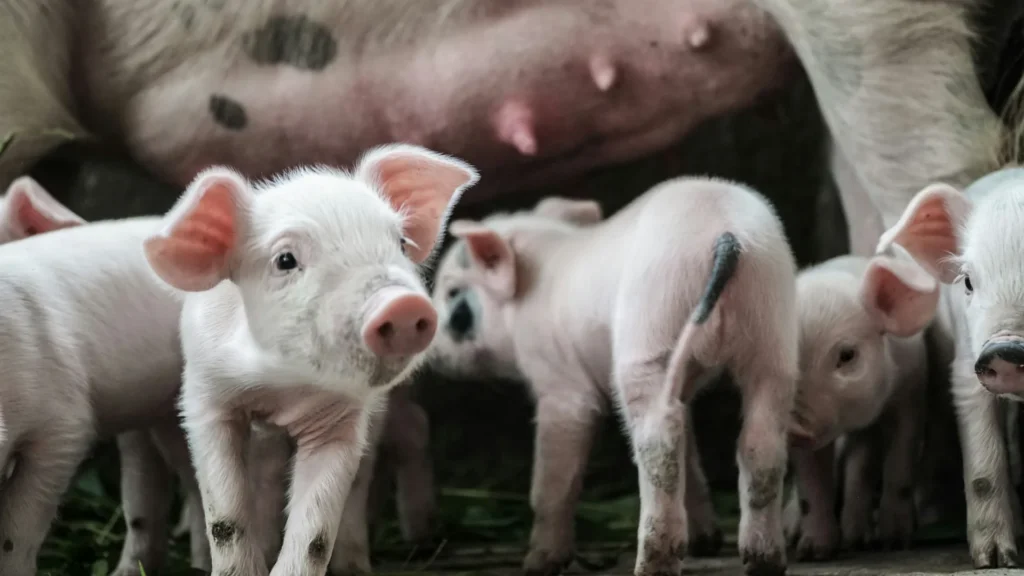
In its judgment of 13 October 2026, the College van Beroep voor het bedrijfsleven (CBb), the Dutch administrative court of last instance for economic matters, upheld the appeal brought by the association Varkens in Nood against the Ministry of Agriculture1. The ban on routine tail docking of piglets is clear and can be enforced under the rules already in force: the ministry, through its inspection authority NVWA, has 6 months to check whether the farmers concerned have breached it.
In the Netherlands the tail is cut off, usually with a cauteriser and without anaesthesia, in around 99% of piglets, even though EU law has prohibited routine docking since 19912.
A ban that stayed on paper
In 2023 Varkens in Nood asked the NVWA to take action against a number of large farms. The inspectors found that tails had been docked, but the ministry rejected the requests. At first it argued that taking action would be disproportionate, because the supply chain was supposedly not yet ready for pigs with intact tails. After the association objected, it changed its argument: the conditions for the exemption were said to be too vague to establish a breach. In short, the rule exists but supposedly cannot be applied.
What the court decided
The rules derive from the EU directive on the protection of pigs3. Partial tail docking is allowed only if the piglet is no more than 4 days old, if injuries to other pigs have been observed, and if the measures taken to prevent tail biting (environment, stocking density, management) have proved ineffective. The CBb held that:
- the ban is the rule: if even one condition is missing, it applies in full. In the court’s view the provision is “sufficiently clear and not open to more than one interpretation” (our translation);
- the rules in force are enough for inspections, without waiting for new rules: the assessment has to be made farm by farm, but that does not make it impossible;
- the burden of proving the exemption lies with the farmer, by any means (the farm vet, a health plan), even without a specific record-keeping obligation;
- the injuries must be observed on the farm where the tails are docked, not by a buyer further down the supply chain;
- a continuous process of reviewing causes and measures is required; a 6-month cycle is considered reasonable.
What now?
The CBb did not itself establish the breaches or impose penalties on the farmers: it quashed the rejection for lack of reasoning and ordered the ministry to decide again within 6 months, presumably after new inspections. The court did, however, stress that its ruling may be relevant to the entire pig sector.
“This judgment means that from now on 21 million pigs a year will be protected from an unequivocally illegal practice” (Frederieke Schouten, director of Varkens in Nood, in the association’s press release)4.
Why it matters for Italy too
Tail biting is a symptom of stress, boredom and barren environments: docking the tail means acting on the animal rather than on the causes. The same directive applies in Italy, transposed by Legislative Decree no. 122/20115. After the European Commission’s audit in November 2017, the Ministry of Health launched a National Plan to phase out tail docking, but progress remains slow: in 2024 farms that do not dock tails accounted for just 14% of national production (farms with at least 300 head), according to ministry figures6.
A Dutch judgment does not bind Italian courts, but an interpretation of a common EU rule given by a court of last instance of a Member State is an argument that carries weight. Principles such as placing the burden of proof on whoever docks the tail, or the irrelevance of the supply chain’s difficulties, hold for any authority called upon to apply the directive.
At ALI we will follow developments in the case and consider how these principles can be used in Italy as well. Our thanks to Dier&Recht for bringing it to our attention.
Notes
- CBb, 13 October 2026, no. 25/991, ECLI:NL:CBB:2026:488, text of the judgment. ↩
- Council Directive 91/630/EEC of 19 November 1991 “laying down minimum standards for the protection of pigs”. The 99% figure comes from Varkens in Nood: press release. ↩
- Council Directive 2008/120/EC of 18 December 2008 “laying down minimum standards for the protection of pigs”, Article 4 and Annex I, Chapter I, point 8; transposed in the Netherlands by Article 2.8 of the “Wet dieren” and Article 2.3(b) of the “Besluit diergeneeskundigen”. ↩
- Varkens in Nood, press release, our translation. ↩
- Legislative Decree no. 122 of 7 July 2011, “Implementation of Directive 2008/120/EC laying down minimum standards for the protection of pigs”. ↩
- Ministry of Health note of 26 July 2024, reported by 3tres3 (19 August 2024, in Italian). ↩